Ep 190 - "From Guitars to Plumbing Franchises"
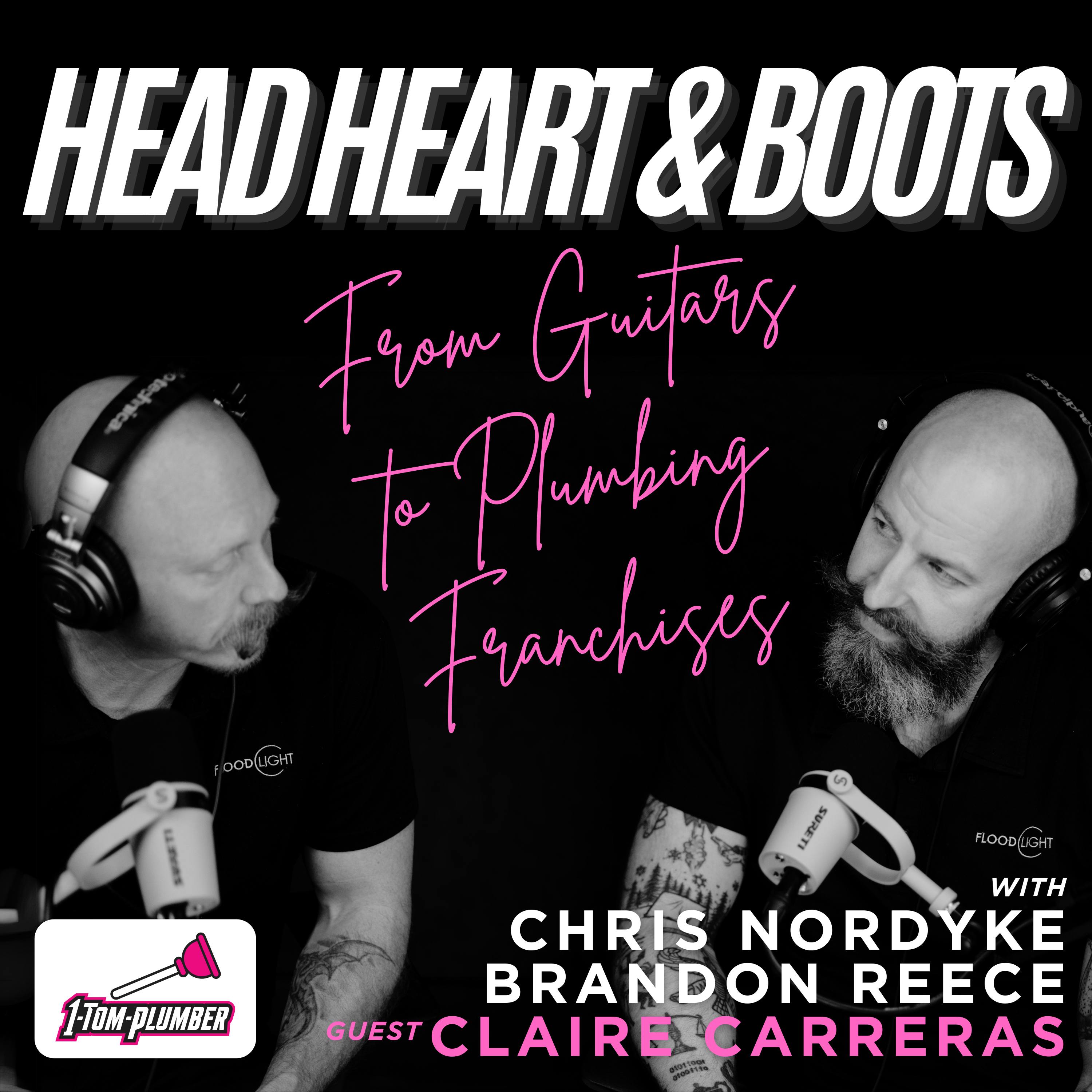


In this episode of Head, Heart, and Boots, Brandon and I sit down with Claire Carreras, a musician, comedian, fashion entrepreneur, and now co-owner of 1-Tom Plumber Austin to unpack one of the most unexpected and compelling career journeys we’ve ever featured. Claire opens up about a childhood marked by constant relocation across multiple countries, how creativity and performance became her anchor, and how those early experiences shaped the grit and resourcefulness she now brings to building service businesses.
We explore the rise and collapse of her fashion brands, the financial devastation of COVID, and what it took to rebuild her life from scratch in a new country. Claire shares the mindset shifts that helped her scale restoration and plumbing operations, the leadership lessons she brought from stages and tour vans, and her refreshingly honest view on managing people, burnout, and generational differences inside a 24/7 business.
If you’re drawn to real entrepreneurial stories, the raw ones, with bruises, resilience, and reinvention; this conversation is worth every minute.
Hope you enjoy.
Chris
Why You Should Listen...
[00:05:15] How a turbulent childhood, constant relocation, and exposure to wildly different cultures forged Claire’s resilience and leadership instincts
[00:13:03] How acting, stand-up comedy, and 15 years of international touring built the confidence, grit, and communication skills she now uses to scale home-service companies
[00:20:27] What three failed fashion businesses taught her about timing, financial risk, market collapse, and how to recover when everything falls apart
[00:28:14] Why she jumped into One-Tom Plumber after COVID wiped out her income, and how she built a 5-truck operation in months by leaning into clarity, systems, and urgency
[00:45:06] How Claire motivates teams through uncertainty, connects personally without lowering standards, and navigates generational differences around pressure and mental health
Did you know...
Only 30% of businesses listed for sale actually find a buyer? Even more striking, just 10% of those sell for the price their owners anticipated or higher, meaning only 3% of all business owners achieve their desired sale price. By focusing on understanding and enhancing your enterprise value, you can significantly boost your chances of joining that successful 3%.
Business Health & Value Assessment
Start Assessment Know Your Enterprise Value. See Your Potential Gaps.
Complete this assessment in less than 15 minutes and receive a free assessment for your business that includes:
- A Lite Valuation Of Your Business
- Your Value Multiplier Per Your Industry
- Health Assessment Per Our PYB Methodology
- Business Value & Growth Roadmap Tailored For You
- Value Acceleration Strategies
Spotlight on Floodlight: Your Secret Weapon for Sales & Scaling
This isn’t a paid plug. It’s real talk from the front lines. If you’ve ever thought, “How do I get a VP-level sales leader or even a sales team without hiring full-time?” Floodlight has the answer.
Fractional Sales Leadership
-
They act as your outsourced VP of Sales, taking full responsibility for training, managing, and growing your sales team. No six-figure hire needed.
-
Clients often close 20 to 50 percent more deals within six months, thanks to data-driven coaching, CRM setup, scripts, and performance reviews.
More at floodlightgrp.com/sales
Commercial Sales MasterCourse
-
A self-paced, video-driven B2B sales course designed specifically for restoration teams. Perfect for building commercial revenue and getting free from TPA handcuffs.
-
Covers mindset, prospecting, pipeline building, LinkedIn lead generation, and includes a $250 discount with code SALESBOOST.
Details at floodlightgrp.com/courses
Tailored Consulting & Coaching
-
Floodlight’s Propel Your Business methodology offers a full-circle roadmap: financials, sales, marketing, leadership, recruiting, productivity. All built for contractors.
-
These aren’t “life coaches.” They’re former restoration owners who’ve lived the chaos and know how to scale out of it.
Explore more at floodlightgrp.com
Live Training, Tools & Strategic Partnerships
-
Floodlight also delivers live onsite and virtual training, keynote speaking, and leadership tracks covering operations, project management, and strategic growth.
-
Bonus: They’ve vetted tools like Xcelerate, Liftify, and Sureti. Floodlight clients get access to exclusive discounts on tech that actually moves the needle.
See all partnerships at floodlightgrp.com/partners
Why it matters for you as a listener
-
You don’t need to figure this stuff out alone.
-
If you’re serious about sales growth, operational clarity, exit readiness, or leadership development, Floodlight is already helping folks like you scale smarter.
-
And you get it from industry insiders. People who’ve sat in your chair, survived the fires, and built systems that actually work.
0:00 All right, dude. We got a good one today, huh? Yeah. Yeah, that's good. I just jumped right in there, didn't I? You're a smart ass. You're such a smart ass. Listen, Claire Carreras. Oh, man. This is just one of those other examples where I feel like a little bit of a buffoon that I haven't, I didn't, we've bumped into Claire at a bunch of different events. One Tom events, core. And I feel a little bit embarrassed, honestly, that I didn't maybe take as many opportunities to lean into conversation or get to know Claire sooner. Because we've been bumping into her at a variety of things, RAA and yada yada. And definitely one of those examples where when you finally get to sit down with somebody and talk with them, you're like, oh shit, I wish.
0:42 Yeah. No, I literally had my mind blown at one point because I was like, holy hell, I would have never put that together. Oh, just so cool. This conversation. I mean, guys, this is... Listeners, not guys. I'm really trying to stop saying guys because there's obviously ladies and stuff that listen to us, but whatever. So hey, everybody. This is one of those true entrepreneur stories. Claire had a really interesting childhood that impacted her in certain ways and a certain family culture that ultimately led to music and stage performing and stand-up comedy and then ultimately pivoted to operating businesses very successfully, which opened doors to owning businesses.
1:30 Oh, it literally... Fashion brands, streetwear, clothing brands, up in Canada, it's like... Oh, it's amazing. And not only is the journey very interesting, but you can just... I mean, that woman has not had an easy journey. run. I mean, I don't think serial entrepreneurship, there's a bunch of easy runs. I think sometimes you run into that rare Midas person that just seems like everything they do ends up winning. But I mean, a very raw and real entrepreneurial journey and the amount of grit that woman must have in her carcass is unbelievable. Well, and the other thing too that I think people should listen for is or they're just going to get, they're going to hear is there's an incredible amount of leadership wisdom that comes out in this.
2:16 You can tell just the way she thinks about things. There's a ton of time and grade just through all these different experiences that you can tell she's bringing to her leadership today, the way she thinks about things. It's pretty cool. You know what I want now more than anything, though, after that? I'm like, oh, if I could get my hands on some footage... of her and the bands back in the day. Wouldn't that be something? Dude, I'm so curious. To see that part of her world. I got to follow up through her and find out if there's like some old Instagram accounts. That's right. Yeah. Well, let's go. Let's dig in. She's a super fun interview and a rad guest. And I'm actually looking forward to taking that conversation on again. Let's do it. Wow.
2:57 How many of you have listened to the Head Heart and Boots podcast? I can't tell you that react how much that means to us. Welcome back to the Head, Heart & Boots podcast. I'm Chris. And I'm Brennan. Join us as we wrestle with what it takes to transform ourselves and the businesses we lead. This new camera angle makes my arms look smaller than yours. I'm noticing that and I really appreciate it. I thought you did that on the show. No, I don't. I didn't. And I am not happy with it. All right. Claire, man, I think we've been working to try to get you on the show for I don't know how many one Tom events that we that we've been talking about it. So we're excited to get this on record. So thanks for joining us today.
3:37 Yeah, man. Absolutely. Thanks for having me, guys. Like you said, we've been kind of circling each other at numerous events and things over the years. And it's just nice to have a sit down finally. You know, I meant to try to catch, you did a breakout, didn't you, at CORE this year? I did, yeah. Right? Yeah, I did. How did that end up going from your perspective? Yeah. It was great. I'm going to be honest. I didn't have, you know, super high hopes. It's the first time I've done any sort of, you know, public speaking of that nature. And I gave the breakout a crazy title that I thought was just going to offend everyone and nobody was going to respond to. I called my breakout session, your team sucks and it's all your fault.
4:17 And I thought that would really, really turn people away. But it was well attended both days and I had a blast with it. And hopefully I think people got some nuggets out of it. So it was fun. 10 out of 10. We'll definitely do it again. I think they call that clickbait. Yeah. Claire. That was Claire. It was well played. Apparently. So give us your background. One of the things in some of our research was that you originally, or earlier in your career, were into fashion design and you were a musician. So certainly hit on that, please. But just give us kind of the workup, you know, from who you were previously, maybe some past lives that kind of led you to plumbing, restoration, kind of your present day stuff.
5:02 And don't forget to talk about the fashion thing and musicians. I kind of grew up as a musician and had some... Did you? Yeah, I had some ambitions that I ultimately set aside for restoration, but you know. I did not know that, Chris. So there you go. Hey, we're out here. Yeah. Yeah. Well, yeah, geez, I've lived a lot of lives, you guys. I've been kind of up and down and all around. But the one thing that has always seemed to stay consistent is I just tend to kind of find myself always within the operational side of things. I really love systems, processes, people, how that all works together. So no matter what industry I was in, that's kind of always where I found myself performing.
5:53 This is so hard to talk about because my family moved, you know, on average at least once a year, if not more. So I didn't really grow up anywhere specifically. We were just constantly moving all across Canada. We went down to Europe. I lived in South America for a while, came back to Canada. I had a really turbulent kind of youth. But the good thing that that brought me was, well, I'm bilingual, which has really served me, especially since moving now to Texas. But I got exposed to just a ton of different people and places and cultures and beliefs around. And I mean, I'm so grateful for that now because that has really single-handedly helped me become the person that I am today.
6:34 Having that exposure at such a young age just really showed me, you know, all these different sides of people and how to work with different people and always being the new girl in school and the new girl on the block and, opened me up to a lot of ridicule. It was a really tough childhood, but it also kind of gave me this edge that I don't think I would have had otherwise. So I kind of coming out of high school, I was living in rural British Columbia, which is in Canada. I had big aspirations of breaking into the arts and entertainment. I moved to Vancouver, which was the bigger city in British Columbia, and I started acting. I was doing acting and stand-up comedy, and I worked in a comedy troupe.
7:17 That was a ton of fun, and then that kind of led me into the music world, and I spent I mean, a decade and a half just performing in numbers of different musical acts and touring all around the world. And, you know, again, just meeting all kinds of people. Well, we can't gloss over this. We got to stop because there's so many interesting little bits that you just like dropped, you know, along the way. It's a lot. You lived, you moved almost every year. Were your parents spies? Were they drug traffickers? Like how did you military? Like what was the nature of that? If I can ask, if you're willing to share. Yeah, you know, that's a really good question.
7:58 I don't. I don't really know. I mean, when I was born, it was just me and my mother. My biological father really wasn't in the picture. Unfortunately, we kind of had to flee away to start over, just the two of us. And then my stepfather came into the picture and he was training to become a naval architect. So then we relocated so that he could get his degree or his master's or whatever faster. So that brought us to Newfoundland, which is the other side of Canada. And we were poor. I mean, we were poor. I'm the oldest of seven now. So there were just more and more kids. And we were always trying to find somewhere affordable to live and, you know, looking for jobs, looking for work.
8:40 And so we just kept on having to be uprooted and moving all around. just looking for opportunities. I mean, at one point, my stepfather in his naval architect career was recruited to go build some very large boats or ships, I guess. And that took us all the way down to South America. So we lived down there for a year and a half, almost two years, and then came back to Canada after that. So it was, we were just always just trying to find that opportunity to kind of establish ourselves as a family and get ahead. The pursuit of that led us many, many places. Wow. And so where, where did music and performance and all of that come along?
9:21 Yeah. So my stepdad, in his spare time, when he wasn't on the computer and working, he really loved flamenco guitar. So he had these beautiful guitars that he would keep locked away from me and he would play at night when he had time. And I wasn't the hugest fan of classical guitar. I mean, I thought it was cool that he had guitars, but obviously, you know, I'm not... Spanish. He's actually from Barcelona, so it's like a very cultural thing for them there. But I grew up around a lot of guitars. And when we immigrated back to Canada after living in South America, you know, that was kind of my preteen era. And I discovered the radio and alternative music and guitars tuned down to like, you know, D and stuff.
10:05 And it just like it blew my mind. It just absolutely blew my mind. And so I would steal his guitars when he was sleeping. I would sneak in and steal his guitars and try to play corn and stuff on them. And of course, he would freak out because that's not how those guitars are meant to be tampered with at all. But I loved it. I was obsessed with music. Music was just this whole new world that I felt like I could relate to all of a sudden. And it gave me, I guess, a sense of a home base. Like, okay, here's people who are singing about something that I can relate to. And here's all these people listening to these songs that they can also relate to me. And it just, it gave me this sense of belonging that I had just never had before. And I started playing guitar.
10:47 My stepfather actually bought me an electric guitar for, I think it was like my 14th birthday. And I would just lock myself in my room with that thing. And I'd be making my mixtapes and it just kind of, kind of all went from there. So guitar and singing. I love that. Singing also? Yeah. Yeah, vocals. Yeah, yeah. Wow, that's incredible. I love the alternative grunge era reference. I commonly make jokes because we're up here in the Northwest, right? So we're all about to enter our chemically depressed state until like Mark... I know all about that. That's the Seattle scene. That's where the ultimate music came from. Everybody was just clinically depressed, I think, for a period of time.
11:28 Oh, for sure. Yeah, man. I mean, BC is just on the other side of that little invisible divider. It gets cold and dark and rainy, and it just goes on and on and on. You got nothing else to hold on to. There's zero sunlight or vitamin D. It's too cold to go see your friends and I can just literally relate to every element of that, not bonding that community that got created, right? That you're no longer feeling like you're alone. There's these people that view the world similarly that I do. And during that time, that was very different. So it was a public recognition of a body of people that in many ways weren't weren't adequately being recognized, at least from our perspective.
12:12 Totally. And this is going to date me for sure. But this is pre-social media. This is before meetups and all this kind of stuff. The radio and CDs. Sam, the CD man, that's what we had. That's what we had to bond over. We had my Walkman and we'd be swapping mixtapes and... It's just, yeah, it was a good time. I love that. I love that. So what happened? Where was that kind of pendulum swing that brought you now into, I don't want to call it the professional world, but more this business-oriented operational part of the world? Because you've just come off the back of being creative for it.
12:54 It sounded like a very long period of time. Yeah, a musician and actor becoming an operations person. What was that? Where'd that come from? Well, it really started for me once I started to dive into the fashion industry. So while I was acting and modeling and doing all my, you know, stand up and all that stuff, I got into the music part of the world. And then, you know, tour was the big thing. Everything was about tour and how we could go on tour and stay on tour as long as possible. which meant I had to get some kind of a day job that would pay me as much as I could possibly earn for where my skills were, and then still have the freedom to go and rehearse and then go tour with my bands.
13:37 And so in pursuit of trying to find some kind of a day job to support people, my passion, I found that I could make a lot more money if I put myself into like a managerial position or some kind of operations position, or if I kind of worked my way up the ladder somewhere. And those were the skills that I realized I had that I could leverage and turn into money that could support me. my dreams, right? Everybody else at that time in my age, you know, we're working at cafes or in a kitchen somewhere and, you know, you're really not making a ton of money. But if you can get in there and then show them that you have this other side that, again, is a lot more valuable to them, then you can get value from that.
14:21 You can get more money from that. So I kind of realized I had a bit of an edge there. And that's kind of how that started to develop. When I got into fashion, again, it was kind of a solution because, okay, now I get to be creative. I get to be myself. I get to have the luxury of time so that when I want to go on tour and I want to rehearse and all this stuff, I'm not tied to it because it's my own business now. But I also had this kind of business savvy that I had gained that I could apply to the business. And it opened up a lot of doors for me there as well. That's super interesting. Was there any kind of third party or outside influence that was helping shape that perspective?
15:02 Or was it really just kind of lived experience one step at a time? Jeez, I mean, I'm sure every adult in my life tried to tell me or, you know, push me in a direction or other, but I'm from the school of hard knocks. I wish I wasn't, but like, that's just kind of how I was when I was younger. So I very much just kind of figured it out on my own. And it came from that need, right? It's like, okay, I need to make as much money as possible so that I can... go tour Europe, right? So how am I going to do that? Well, I'm going to take a job that I otherwise would never consider. I got into all kinds of stuff. I was doing, I was working at a SaaS company for a while. I was working in medical hair loss replacement. Like I was taking these crazy jobs, but with the goal of getting into more of that management operations.
15:49 Let me help you run your business and make your business profitable and work so that you can reward me with more money so that I can get out of here and go do what I really want to do. Yeah. So the fashion piece, you were the entrepreneur during that phase. Yeah. Is that right? What was that? What was going on? Did you build a brand or what? My first fashion business... I actually, I launched it with my mom. My mom and I, we started a fashion brand. It was kind of like street wear meets athletic wear for the young lady. And so I designed, manufactured, developed it. My mom kind of helped me with the sales side of things. And we just kind of did our best to take over the world.
16:32 I mean, within a year, we had eight big commercial wholesale accounts all over British Columbia. We were locally manufacturing, which was a big thing at the time, using a lot of eco fabrics, bamboos, jerseys, things like that. And, you know, again, I just had an absolute blast with that. And it taught me a lot. It really taught me a lot about, you know, things that I hadn't at that time experienced, like the logistics of production. and how to plan things out. The fashion cycle is, a lot of the time, it's like a year in advance. And then getting out in front of promoting the brand, because now you're also the face of this product. And then when my mom kind of left the sales role, I took over that.
17:13 And then now I'm essentially touring all over Canada, promoting my brand with my trunk show. I got a little suitcase with all my samples, and I'm going... to stores and introducing the line. And so, you know, again, I just earned a tremendous amount of experience launching that business and I learned a lot really, really fast. And that was my first one. And then after that, I started a fashion consulting business where I did kind of boutique manufacturing for other brands who wanted local manufacturing. But maybe they weren't at the size yet where they could get like a big manufacturing company. You know, they're doing SKUs of like maybe a hundred or less in any style.
17:54 So they needed a smaller manufacturing house. So I became that manufacturing house and I would develop the patterns and, you know, kind of help them grow and go from there. So I was servicing, I can't remember, maybe like 10 or 12 different fashion brands in. and offering services to them. That was a lot of fun. And then after that, I took a little break from fashion, ultimately came back to it. I launched a vegan leather bag and accessory brand. And that was a lot of fun. That was probably my best one. This is so wild. Okay, so for people listening, it's hard to create the context for this, right? So from Chris and I's perspective, we meet people like you, Claire, at an event, at a franchise group, or whatever the case may be.
18:40 You know this. We all kind of create this story of who Claire is. And then to sit down in a show and hear so far in only a few minutes what the journey of your life has looked like before you even hit one. It's so much. It's unbelievable. So weird question, but in my mind, here you are this creative. You've learned how to, over years, put yourself out on stage in public, right? And being in front and for all intents and purposes, being rawly who you are in front of people. When you went out and now we're having to sell and put this brand in front of people, were you ready to go?
19:22 You had already been putting yourself out in front of people. Was there any imposter syndrome? Was there fear to overcome? What did that look like? Oh, I mean, there's always imposter syndrome. I mean, for me personally, I mean, no matter how many times I've been up on a stage or been performing a song or doing a sketch or, you know, whatever, doing a scene, you know, what have you. I mean, I always have that. that little voice in the back of my head just been like, you don't even know what you're doing and they're all going to see it. And like, you know, the negative self-talk that you, you have sometimes, that's one of the demons, I guess, that I still have to continually work on to not let those voices get me down.
20:03 But, you know, at a certain point when I'm up in front of a crowd and I'm doing my thing, it does all melt away. And I just kind of just can be myself and yeah. In the zone. Yeah. Yeah, I'm getting this on. So these fashion companies, how did they culminate? Like when you moved on, did you sell them to another brand? Did you just close down those businesses? And maybe what did you learn along the way as you exited those businesses? Yeah, you know, I wish I had it. prepared. I think two of them probably could have been sold, but I was just too young at the time and circumstances kind of didn't line up. The first business I had, this was right around 2007, 2008, when, you know, of course, everything just kind of collapsed.
20:48 So what happened with that was all of my commercial accounts, all of a sudden just didn't have any money. And they couldn't pay me on time. So, you know, we'd have a net 60 or whatever. So I would have gone into production, sewn everything, delivered everything. And then after a certain period, they're supposed to then start making payments. They couldn't make those payments. So my whole production cycle just stalled out because without that money coming back in, I can't now reinvest that into the next collection to manufacture that. Because again, with fashion, we're, you know, six months to a year ahead of, of when it's actually going to be in the stores. So that financial collapse really just threw the whole business under.
21:31 It just crushed us. So kind of just had to fold the whole thing down. With the consulting business, that was going great. I mean, I had more customers than I could service. Everything was awesome, but I was running the whole operation out of my home. And at that time, I was with my first husband and unfortunately that relationship fell apart and we separated. I had to leave. So I no longer had a space to operate out of. And I basically had to just start over from scratch. At that point, I had not gone to business school. I had no formal education. I had a lot of skill and a lot of people knew who I was in the community, but I had Nowhere to operate.
22:17 I had no car. I had nothing. I kind of just had to put my life back together from zero. So that was really sad. But it's all good because, again, it put me on the path to where I am now. And when I was ready to get back into fashion, I was able to launch bigger and better than I ever could have had I stayed in that situation. And then, unfortunately, COVID happened. And I was selling travel accessories. Oh my gosh. Yeah. Yeah. So really, really unfortunate timing for me. And who could have predicted, right? And I struggled to stay alive through that, to try to recoup as much as I could.
23:00 But I mean, I had just invested a ton of money in my second collection with that brand. And we were manufacturing overseas and COVID. I mean, the whole, you know... global trade just absolutely collapsed on itself. So all of my numbers and projections just went out the window. Everything that I had planned basically was just no longer valid. I had a ton of inventory that all of a sudden I couldn't move. Nobody was buying my product, you know, commercially because stores are shut down. And my price point just went crazy on me because I'm having to ship things when containers are just not moving. So the whole thing went sideways on me.
23:42 And at that point, I was also in the middle of immigrating to a brand new country, coming to America during a global pandemic. And everything just fell apart. And by the time we got to the other side of COVID, I was so financially ruined that I All I could do was try to figure out, okay, how do I get back on my feet? How do I undo basically two years of being in an incredible amount of debt and not having any income? And being in a brand new country with no access to credit or a car or a license, and I wasn't legal to work here for a year and a half of that because the immigration offices shut down and they closed the border.
24:26 So I couldn't even go back to Canada. Like it was a disaster, guys. It was an absolute disaster. Yeah, yeah. And we were... Really? Incredible. It's just cranked up about 10x. Wow. I've got some real-life battle scars that many entrepreneurs and business owners... I'm sure can relate to. Yeah. What just an absolute pointer towards the grit that you've got on deck. That's unbelievable. So how in the hell, after that much... challenge, we'll say, what is it that makes you still go after being a business owner? Like, why would you continue the entrepreneurial pursuit after that experience?
25:08 What is it? I mean, it's crazy, right? But it's exciting. I don't like what else would I do? I mean, yeah, that's a great question. Maybe I'm just insane. But... I love it so much and it drives me. And when I'm, when I'm not aggressively in pursuit of something, I'm miserable. You know, I'll, I'll go through these phases, especially after like these, you know, epic failures of, you know, cataclysms of time and, you know, all of this stuff. And I'll be like, yeah, you know, like maybe I'll just go get a little job somewhere. Maybe I'll just be a receptionist or something, you know, and just, take it easy and just, you know, make a little money and just chill.
25:51 And I could try to do that for like maybe a month or two. And I would, I would just hate it so intensely. It's just not who I am. I need, I'm like a border collie. Okay. If I don't have a job to do every single day, that is almost impossible to achieve. I'm just not happy. And I'm chewing up the furniture and I'm a menace to society. How long did it take you to figure that out? Because that level of self-awareness is pretty important, but many of us still don't have it. So when did that start showing up? I think if my mom was still here, she'd tell you that's always been me since day one. I was the kid, she would have to have stacks and stacks of sketchbooks and coloring pencils and Play-Doh and every morning she'd have to be like, okay, Claire, here's what we're going to do today.
26:41 I need you to make me four vases out of this clay and I need you to draw me four horses and... And they need to be colored and the outlines have to be perfect. And then I need you to write me two stories about dragons. And she just gave me like this crazy list of things to do. And I'd be like, all right, okay, perfect. Awesome. I'll get, I'll get right to that. And it would keep me busy because if she didn't do that, I would literally be out there just causing havoc and just like, just an absolute menace. I was such a handful as a child. I, I, I wish so badly that my mom was still here so I could tell her, thank you so much for putting up with me because what a handful. And I'm the oldest of seven.
27:22 She had all these other kids that she had to pay attention to. And I was just so needy in that I just I needed things to do. I needed a purpose. And it needed to be constant. Otherwise, I just would fall apart and take everybody with me. Yeah. Unbelievable. So I'm going to shift us kind of here because I want to give you a chance to start sharing with us some of these kind of leadership lessons that you've been gaining. Because we've seen some of it in real life. I've heard more about it in real life. And I know that there's a lot packed under all those life experiences that you just shared. So real quick, though, before we get into that, let's get current.
28:03 So right now you got a pink shirt on. Tell us where you put your bets in, right? And what you're doing. And then I've got a list of questions I want to tear into with you. Yeah. Absolutely. So I am currently co-owner of One Tom Plummer of Austin. We have been open officially since July. So pretty new, pretty recent. But yeah, loving every minute of that. We have an awesome office that we built out. Got a great team of people. We've got five trucks on the road now and we're just rocking and rolling out there. Yeah. Home services. It's, it seems like a huge jump because we just finished talking about all this, you know, arts and stuff that I was doing.
28:44 But essentially after COVID, once I was finally legal to work in the United States of America, like I said, I was on this mission to like, crawl out of this hole of debt that we had found ourselves in. So I just started blanketing the internet with resumes, which of course, nobody was going to look at me because I had a two year gap on my resume and all my references for, from another country. So not the most appealing candidate. And it just so happens that the first person who responded to, to one of my inquiries for, for employment was an individual who owned a restoration company. And that's how I fell into restoration. And that led me to, you know, a few other kind of home service experiences and ultimately opened the door to one Tom.
29:30 And here I am. Now, one Tom, is it operating independent? Are you guys partnered with a restoration company? Like, what's that enragement look like? Yeah, no, correct. So One Tom Plumber is, you know, it's an emergency plumbing service, right? We really cater to the 24-7. We do commercial and residential. If you've got a problem, we're here to solve it as quickly as possible. So it pairs beautifully with a restoration company because it's that same urgency, you know, especially when we're talking about mitigation. Yeah. the first question we ask, you know, in mitigation is, has a plumber been on site? Because of course we can't begin to do any kind of structural dry out if there's still an active leak.
30:12 So the two go really, really well, hand in hand. And I was working for a restoration company and I had, hit a point in that journey where I had really accomplished all the things that I had joined him to do. We'd hit all the goals that I'd set out to do. We'd built what we wanted to build. I'd scaled beyond what he had asked me to scale. And I was kind of getting that itch of like, okay, well, you know, I don't have anything to aggressively pursue anymore because I've kind of, we've arrived. And that's when one Tom kind of came across our desk and he said, hey, you know, why don't we partner on this? You know, why don't you stop being an employee? Why don't we be And how about you run this business, you know, do what you did over here, do it over there.
30:57 And I'll stay here and run the restoration company and we'll just do this thing together. And so that's what we did. That's epic. So how long were you with the, are you able to talk about the name of the restoration? Yeah, yeah, yeah, for sure. It's called Atex Restoration. It's an independently owned restoration company in Austin, Texas. I think they're going into the 15th year of operation. And I was with them for... Oh, geez. It feels like forever, but I think it was really only like a year and a half, maybe two years, probably more like a year and a half. I actually came to him from a different home service company. I was operating a pool cleaning and repair company, fixed that all up, made it nice, was able to help him then sell it.
31:46 And then he was like, well, I have this restoration business over here. We've basically just worked you out of a job. Why don't you come over here and do what you did for the pool company over here? You know, he had these really grand ideas. He wanted to scale. He wanted to get the restoration side of it really rocking and rolling. He wanted to fix up the mitigation division and make that, you know, a little more streamlined, a little more efficient. And he wanted to add contents and he just wanted to scale. Like he wanted to go big, right? with this whole thing. I said, all right, yeah, yeah. You know, I can, I can definitely help you do that. I think I can do it. I think I can do it in a year or two. And he was like, no, no, this is like a three or five year thing. And I'm like, yeah, we'll see.
32:27 And yeah, sure enough, within a year and a half, I mean, I'd done everything that we had set out to do and I was super proud of our achievements. But again, like I'm I just have this like weird thing that if I don't have a challenge to aggressively pursue, I just I just get all antsy and idle hands lead to lead to bad things. So. I think he saw that and I think he was looking for some kind of opportunity to keep working with me, but also satisfy, you know, kind of what I needed out of life. Because this is now what, 2023, I guess that would have been. So, you know, we're talking three years of me.
33:11 like insanely working to just get myself out of the hole that COVID left. And I had started to turn everything around. And now I was kind of like, okay, like, you know, maybe I can slow down a little bit. Maybe I can think about... What do I really want to do? Because you also have to have this conversation with yourself of like, okay, I've been going like turbo speed, trying to hit this goal to get my life turned back around. And it looks like I'm almost there. Like I can see the horizon now. I can see the sunlight starting to get closer. What next? Do I go back into my passions? Do I start playing music again?
33:51 Do I take a little sabbatical? Maybe stop working so hard? Maybe start enjoying music? this new country that I lived in that I haven't really had a chance to explore or have any fun because I've just been like frantically trying to get back up off the ground. And ultimately I was like, well, I know, I know what happens when I do that. Every time I try to do that, I realize that I'm miserable and I'm bored and then nobody around me can be happy because I'm not happy. So you know what, let's, let's launch another business. That sounds perfect. You mean all this time you weren't hanging out at Barton Springs and on Sixth Street, like eating all the tacos and hanging out in all the bars and clubs? Man, I'll tell you something.
34:32 I have no friends. That's like one thing I do wish like, you know, now I feel like now that I'm where I'm at now, I'm like, okay, it's time, Claire. Yeah. You could probably afford to go out, you know, a night here or there, you know, socialize a little bit. It's such a departure from who I used to be, you know, not even like five or six years ago. I was I was always out. I was low key kind of a socialite. You know, everybody, every bar knew who I was. I was on all the guest lists. I was always going out, seeing shows. rocking and rolling and now I'm just a homebody if I'm not working I'm probably asleep and those are the only two modes that I have and uh you know at some point you kind of have to think about your quality of life and you know what is the point what is the point of all of this like you know I've gotten myself out of the hole now what no you got to smell the flowers every now and then otherwise you know time just keeps going and it just goes faster and faster every year Are you a business that's under five million in sales and you're just now getting ready to try and scale your company up and hit some of those targets you've always wanted to hit, but now you've got to build a sales team?
35:40 Or maybe you just hired your first sales rep, but you don't really know how to manage them. Like how do you manage, lead, train, develop a sales rep? Floodlight has a solution for you now. So we can actually assign your sales rep a turnkey VP of sales that will help them create a sales blueprint, their own personal sales plan for your market, They'll have weekly one-on-ones with that sales rep to coach, mentor them, hold them accountable to the plan. And they'll also have a monthly owner's meeting where they'll meet with you or your general manager and review the progress of that sales rep. Their plan to actual results, what kind of performance improvement they're working on with them. Also let them know, hey, you might, they're doing really well. Maybe we should think of hiring a second sales rep. They're going to have that one-to-one advice for you as an owner or senior leader on the team as well.
36:25 How great would that be to have a bolt-on sales manager for your one sales rep and it's only $2,500 a month? If you're interested in talking more about that, reach out. Let's grab some time and let's talk shop. Our floodlight clients this last year in 2024 generated over $250 million in revenue. Supported by, advised by, an industry expert who's owned and operated a business just like you. So take action. Don't kick the can down the road. Start with our business health and value assessment, and let's unlock the next chapter of your success story. Speaking of fast, okay, because you said this kind of flippantly, and I've processed it a couple times since you said it.
37:05 When did you guys start your one, Tom? July. July of 2025. Correct, yeah, this year. So I was at Atex, still in my operations role, until April of this year. And then it was like one week I was at Atex, the next week I was at one time. And then I just hit that really, really hard and we got off the ground and open. And yeah, it's been a rollercoaster ride. Yeah, to be up to five trucks already. I mean, I think a lot of single trade and entrepreneurs that are listening, they know what it was like when they launched their resto company. And to get up to five trucks, there's a lot of pain that can come during that time frame.
37:50 And there's a lot of big shifts that have to take place mentally to hit that number. Yeah. I wouldn't recommend that for anybody, like for everyone. There's a lot of ways just to start a business. My partner and I, we very intentionally chose to not bootstrap it in the beginning. We had a very clear vision of where we wanted to get it to and how we wanted it to look in our territory. And we, you know, very fortunately had access to the capital to be able to be like, all right, like we're just going to do it. Yeah. I'm so grateful that he has so much confidence in me and my skills and my ability to say, yeah, I trust this person to do it and execute it and be successful.
38:33 Because five trucks is a lot. We started with three, we added another one, and then we added another one. Wow. I mean, even launching right out of the gate with three, I mean, we've been on the ground with several, like quite a few of the one Tom franchisees owners. And it's a lift. I mean, any business is a lift. But there's definitely some things when you're in a 24-7 nature like we are on both sides of the fence, the one Tom and us on this industry, like that's a whole nother level of grind associated with your business. It's one thing to put a 24-7 expectation on yourself as an entrepreneur because you want to learn and grind and build the business, but then when the client has a 24-7 expectation too. Yeah, when they're calling and you're still the person answering the calls and you're like, oh boy, all right, no, it is legitimately 3 o'clock in the morning and yeah, okay, we're doing this here.
39:24 So I just keep like in my head, I'm trying to put together these two seemingly disparate things of creative, entrepreneur. You've done all the things. You put on your selling shoes and with your fashion businesses. You perform on stage. You've done all of these things. I'm really trying. Can you unpack for us a little bit? Like when you said to the owner at Atex, hey, I see your big vision and I can help you build that. And you go in, and in a year and a half-ish, you help them scale out to basically exactly what they wanted to do. Talk to me about where did that confidence come from?
40:05 Like, what's your mental framework for operational things? Like becoming profitable, establishing clear lines of communication. Like, what was your thinking when you stepped into that role? I mean, I know it wasn't your first rodeo. You had the pool business. But at that point, what did you learn about business and your own skill to say, well, I know how to scale businesses or I have a clear vision of how to go about this? Like unpack, what were some of those principles, decision-making process, whatever that you had gained at that point? I mean, it's kind of, and not to take anything away from how difficult all of this stuff that I undertook was, but in a lot of ways, it's all kind of the same.
40:48 I think about when I put the first band that I joined and we just had this idea of, yeah, you know, we're going to play shows. We're going to do it. Okay. Well, how are we going to do that? All right. We have the end goal. We have the end vision. And then you got to just kind of like scale it back. All right. How are we going to get there? What do those steps look like? Who do we have? Who do we need? How do we achieve this goal? And it's the same with anything, whether you're launching a fashion business and you're like, all right, well, I want to have three collections in the next three years. Okay, great. What does that look like? What are the steps we need to take? Literally getting out a calendar and being like, all right, well, if I want this by then, then, okay, step one.
41:28 Step two, you know, you just, you break it down into pieces and then you look at, okay, well, who do I need? Who do I have? How am I going to get there? You're not going to do it by yourself, ever. That's... That's the number one lesson that I'm glad I learned early on. You don't get there by yourself. And it's the same with pool company. It's the same with restoration. It's been the same with one time. When you're building this thing out, it's important that you have a very clear vision of what you want it to look like at the end, keeping in mind that that's going to evolve and it's going to change as you kind of, But you do need to have something pretty definitive to work towards. Otherwise, you know, we're leading people where, right?
42:11 We have to have something to hold on to, whether it's, you know, our summer tour of Europe in 2018, or if it's, hey, we're going to hit this revenue margin by this month. And you got to get everybody who's on that journey with you. on board and invested in that same goal. And yeah, and then the work starts, right? Then I'm like, okay, we've got this roadmap. We know where we're going. We have an idea on how we're going to get there. Here's the people I have. Here's the people I feel like we need to find to help us get there. And we just kind of start moving. And along that road, you know, things are going to change. Unexpected things are going to happen. Maybe the people you thought you were going to have change or the people you think you're going to find You don't, and you have to adapt and just keep moving forward.
43:00 So one of the themes that I feel like has been super present in your career is, one, you've taken a lot of shots at startup. So you've been in startup phase a lot of your professional career. And then on top of that, you've lived inside the chaotic environment of disaster restoration. Now you're back in startup phase. And so there's kind of this combination of things happening for most business owners and leaders in any given year, right? One, you're in some form of that. Startup, launch, bootstrapping, whatever. But then there's this other thing that I think 2025 has reminded a lot of people of is that sometimes years are not fun.
43:42 And there's many disaster restoration companies this year. Ours are not insulated from that. We're experiencing similar things where it's not been fun. This has been a tough year. And so in that startup phase and the chaos of the industry, or if you're in a company that this year did not have the most exciting financial opportunity in the world, There is stress and anxiety and pressure inside the organization that look and feel very similar, right? Regardless of those cases. Yes. What have you done? What is your perspective? Maybe some of the mindset that you lean into. What's the communication that you provide your people to keep them?
44:24 For instance, in those early stages, you don't have all the things in place yet. You've got dreams and aspirations, but it's kind of wishing still, right? And so you're having to motivate people like, trust me, it's going to be what I think it's going to be, right? Or you've got people that they feel the pressure of crisis. Yeah. And you're having to still apply pressure for accountability and forward movement. But yet, there's this sensitivity around your people because they feel this negative pressure from whatever that environment is creating. So just help me understand your perspective. And what specifically have you done to create trust and continue the team rowing in the same direction with you in either one of those scenarios?
45:06 Yeah. Oh man, Brandon, I'm so glad you said that because that is absolutely the hardest part, especially from a startup perspective, because you're really out there selling a dream. You're selling something that you wish, you think, you hope, but you don't really know. You're pretty sure you can pull this off, but I don't know. And then the imposter syndrome stuff starts happening and you have to find a way to keep these people invested in this dream that you're selling. and convince them that it's their dream as well, or at least keep reminding them of it while you're still trying to figure it all out. And it's not a smooth ride. It's very bumpy. And that can be really alarming and uncomfortable for people, especially if you're joining a company and you've never been a part of a startup before.
45:53 it's probably one of the most uncomfortable things you could put somebody through. So you just really, really, really have to spend the time with your people to keep reiterating what the goal is, why it's the goal, how we're going to get there, how we're going to get there together, how... we're all participating in this thing. And like, yeah, it is going to be kind of funky. And yeah, we're going to make some mistakes. And hey, you know what, I don't have an answer for that yet, because we haven't figured that out yet. I'm literally when I get home today, I'm going to work until one o'clock in the morning to try to get to that answer tomorrow. But right now today, I don't have that answer. And, you know, just hoping and praying every day that everybody kind of stays cool and continues to participate with you.
46:37 But in that chaos, if you're able to present it in a way that, you can really get people excited, you know, and it's, I don't want to say like we're inflating anything or kind of like, yeah, like look over here. Woohoo. It's all going to be great. You know, but it's that camaraderie. It's the same kind of camaraderie you have when you're on tour with, with five guys that you, you've known for six months and you've only really known them in the capacity of, all right, we meet up every Thursday and Tuesday and we jam for an hour and then we go home and we don't really know that much about each other. But in two weeks from now, we're going to jump on a plane and we're going to rent a vehicle and we're going to tour, you know, down the coast for a month and a half and we're going to hope that we survive.
47:28 And then things start going wrong. You know, one of the venues forgot to promote you or whatever, They didn't give us the right spot or there was no money at the end of the show when the truck breaks down and you got no way. All these really high stress things are happening and you start to see everybody's flaws and you start to see everybody's hope kind of start to dwindle. And it's really hard to get people motivated again because it's like, hey, we got to get up on the stage and we got to rock people's socks off and we have to win this audience and we have to sell merch. Otherwise, we're not. we're all going to die, you know, like it's that extreme. And I guess having gone through that, I've kind of learned what it takes to get people motivated and excited about a common goal.
48:15 And that's really the thing of it. It can't just be my dream. You know what I mean? It has to be our dream. And if my goal needs to change a little bit to incorporate some of what they need to get out of this, then absolutely. Like, let's talk about it. What do you need to get out of this? What does your part of this dream look like? And then I can explain, OK, well, here's how we're going to we're going to achieve all of this together. And these are the steps that we're going to have to take. And we're going to have to hold each other accountable and we're going to have to show up every day. ready to rock the show and win the crowd and sell some merch and make these people happy so that we can get to where we're trying to go.
48:57 And when we get there, we have gotten there together and we'll have had this amazing experience together that nobody else will have had. And that's just so beautiful. Okay, so I'm in my mind right now. I'm wrestling with a conversation that literally Wayne and I and Steve were a part of today with our own team where we're doing a little bit of a guys, this is important because there's some stories in our head. We've started to develop a reasoning on our own of why we want this data to be accurate or why we want you in this CRM on this consistency and taking note of these specifics inside the database or whatever the case may be.
49:42 And... Sometimes what happens is my ability to anticipate or understand the value of this action or this activity seems really obvious. And I'll have meetings with the team and we'll talk about the idea or the concept. And then two weeks later, go by and I realize, man, there is a lot of friction still in getting buy-in. Yeah. something's off. Like clearly my understanding of the value of this activity or the use of this tool is not the same as my team member. And so you get into these meetings where you try to unpack that and find out where the gap is between your perspective and theirs. And you can kind of just read it on their body language in these times of stress or startup or chaos where it's like, They almost lack the energy to get excited about what you're asking them to do.
50:33 And some of that is individual, but sometimes it's just the grind of the job or grind of the state of the business. have you found any type of conversation or any phrasing or any approach that's made it easier for you to help them kind of dig out of that and get back on the surface of the quicksand, if you will, and be willing, right, to continue to put the effort in that's good for them and the business, right? Yeah, geez, I wish I did have like a magic phrase or a statement, but I really don't. I mean, to me, it just comes down to person and, you know, people, you know, like I really spend a lot of time with my people and I do my best to really get to know who they are, you know, inside of the role and outside of the role and what motivates them and what do they care about and what do they want?
51:25 Because everybody is different in that capacity, you know, not everybody... is going to get on board with the things that you think they're going to get on board on. Not everybody's motivated by money. Not everybody is motivated by, you know, achieving this like crazy goal together. Some people are like, yeah, I just kind of want to clock in and do my thing and go home. You know, but I feel like the more time you spend with your people and the more you understand who they are and what does make them tick, then it's a lot easier to have those conversations and be able to present things in a way that they are going to understand and they're going to click with. You know, and again, it goes back to, you know, you have this dream, but it's not just your dream.
52:08 It has to be everybody's dream. So how can you show them that their dream exists within this, this world that you're creating? And how can you help them also get there and get their comeuppance and, you know, their kicks out of it, right? And, you know, sometimes they just don't, you know, sometimes you're not going to win them all. A startup is a very, very difficult place to be. It takes a certain type of person to be willing to go through that kind of turmoil until you get there. But I've found in knowing my people and understanding who they are and what they want out of life, I can usually find a way to kind of highlight like, hey, like, this is how we get you what you what you want.
52:52 And here's how that's going to also benefit all of us. And here's how we're all going to still be moving in the same direction that we all win in the end. Yeah, I love that. Quick question along those same lines. What's your mental process for for knowing when? to coach up or coach out. Like what's kind of your mental process for when do we need to just move on? Because this individual is not right for the team or right for this time in the business. Yeah. Yeah. And that's, that's always the toughest one too, but it's important not to ignore that. If you are getting some signs like, you know, maybe this just isn't the right fit and there's no sense in trying to, you know, push a square into a round hole, so to speak.
53:37 That's, that's a tough one. I, and, you know, I've been really fortunate to have had the different teams and the different people in my professional life that I have, I've always been able to talk to them about that and kind of get them to be transparent and honest with me. If they have any inkling that like, Hey, maybe this isn't for me and I can kind of help them weigh out those pros and cons of like, Hey, is, is this right for you? Is this what you want? And if not, you know, Hey, like, that's okay. You know, like it doesn't have to be a blow up. It doesn't have to be a problem. But like, let's just, let's figure it out so that you're not unhappy, you know?
54:19 And I'll do everything I can to help you move to wherever it is you need to be. I would love to try to coach everybody up. You know, I'd love to at least give it a shot, but again, it depends on the person, right? If they're open to it, if they're willing to, or they might just already kind of be like, you know what? I, I, I've already kind of decided that this isn't for me. And then you kind of, you know, you got to pull the cord. But you don't get that unless your people feel comfortable talking to you and sharing those things with you. And sometimes, unfortunately, if they're not, then you're just kind of seeing the signs and you just have to make some tough choices. I hope that answered your question.
55:00 It's a tough one. Yeah, you're right. You know, one of the things that I run into, I feel like, is some difficulty in valuing. This is going to come across probably negative, but I can struggle with valuing the difference correctly between me, my life story, my background, what drives me, what motivates me. And what I mean by that is working hours, things that will slow somebody else down from making progress versus me. Things that maybe a downline employee gets high-centered on that I would just blow through. This gap between what has created my persona, my operational cadence and expectation on myself versus...
55:46 My struggle sometimes with my downline team were how easy it is for them to get knocked off course, to get delayed, to receive enough pushback that it slows them down or puts them in a paralysis state. Or, you know, easier for them to come up with a reason or an excuse they don't have the ability to win or move forward. I'm sure you know exactly what I mean. And I think what I wrestle with sometimes in my mind is remembering my life story, my experiences, my relationships, a lot of that drives that orientation for me. And just because someone else hasn't had those same experiences to maybe create the same...
56:27 level of drive, right? Especially if we're talking generational. Sometimes there's just things that take place that just create a difference. And I'm trying to use the term difference very intentionally right now because what I have a tendency to do is put a value statement on it. If you're more like me, you're good. If you're not, it's bad. And I think where I'm going with this is from your perspective as a leader, I'm hearing a lot of the way that you talk and communicate and phrase how you interact with your people, I'm not necessarily hearing that judgment. It sounds like there's some more empathy, some more, I don't know. I don't want to make the judgment or the assumption. So, Question. How do you bridge that gap?
57:10 How do you refrain from... Because you're a gritty mofo. Like your life, dude. Like there's not very many people that would keep picking their self off the fucking ground and doing what you're doing. And so I would imagine it's hard for you in an environment with nine out of 10 people to really feel like you're facing a peer because of what you're capable of going through and what little they're capable of going through. So here is the question. How do you bridge that gap? How do you have the patience for some of these team members or these individuals in your sphere of influence that are a long ways away from being able to grind the way that you grind, right? And do what you're able to do.
57:51 How do you do that? I mean, you've really got to separate the fact. Like, I really, really do my best to not judge and base how I feel about other people, comparing them to myself. Because I am very, very aware that I am a highly irregular person. I mean, I've just lived... such an insane life and I have been exposed to so many people and places and things and hardships and amazing adventures and, you know, all of this stuff. But I'm also very, very aware that that is not normal and that is not the usual.
58:33 And most people I interact with are not going to have those same perspectives as I am. And, you know, ultimately, I'm not going to have The bluntest thing I can say is all people are flawed. All people are flawed. And we have to have some empathy for that and just consider that, okay, it's okay to be flawed. As long, you know, if I can understand in what ways you're flawed, like we can work with that. You know what I mean? Because... We're all like that. You know, think of the coolest lead singer that you could ever imagine. I guarantee you when they're not on the stage and they're in the tour van and they're, you know, five whiskeys deep, they probably have some problems that nobody is aware of.
59:15 And they're probably pretty difficult to deal with a lot of the time. But that doesn't make them a bad person. It doesn't make them somebody that's not worth your time or effort. It doesn't make them any less of a performer. You know what I mean? But you do have to handle them in a different way. And I wouldn't be able to compare them to myself or to somebody else because that just wouldn't be fair. So, yeah, I guess I do have a lot of empathy for that because I've just been around so many different people from so many different walks of life. I feel like I'm a pretty, a pretty open and accepting person. And I, you know, I genuinely want to help and I want to lift the people around me up, but you know, I'm flawed as well.
1:00:00 You know, like I'm, I'm a super impatient person. Like I want, I want to go, I want to go, I want to get there. I want the things to get achieved and I want to, you know, I want to plow through life. And, you know, I've had to learn that most people don't think that way. And it's abrasive to them. If I'm coming on too, too hard, given too much of that border collar energy, right? They don't want to see this dog like staring at them and like creeping, like it freaks people out. You have to, wind it back and try to play nicely at the dog park with everybody else. Right. So it's, it's, and you know, you mentioned the generational thing. That's absolutely, you know, something to consider different people from different age groups have different perspectives on what, you know, work looks like, what, what work behavior looks like, the way that things are done.
1:00:51 I mean, it's a very, it's very different and, and, To me, a good leader is somebody who takes all of that into consideration and tries to find a way to identify the things that we all have in common and try to kind of focus on that. But also acknowledging all the things that we have that are different and how can we learn from each other in that capacity so that we can still see how we're all helping each other go in the same direction. I was, I'm not going to use any names because they're too close to my own sphere. But I had an experience this week that was kind of shocking. I have a person in my life, two persons in my life that I trust.
1:01:34 I respect a lot. I love them both to death. Younger. So they are definitely the younger generation. So both these individuals are in their 20s. And both of them I would put next to the average person in their sphere. And I would be like, man, these two, they're top tier. I love them to death. They got the juice. They're going to do great things. And then I realized how easy it is. And I know if they listen to this, I'm going to get in trouble. But I realized one day, because they were at home during the workday, both these individuals. And they're not remote workers. And they had a real quick response to why they needed to take that day off and why they weren't at work.
1:02:20 And both of them are wrestling with how do I continue to develop in my career, advance in my ability to earn money, all the things. And I realized there's a generational thing and I can't put my finger on it. And again, I'm trying not to place value on this. I'm just stating something I've witnessed. where it's just more acceptable to them to take a day for themselves, in quotes. A mental health day. Mental health day, whatever, whatever we tag it, right? And again, I'm not, I'm not being tongue in cheek. But I just found myself in that moment going, look, there's a reality as an individual that you need to be in alignment with what you want from life and what actions are going to be required in order for you to achieve that want.
1:03:05 Yeah. And behavior, like I was made aware of, is glaringly out of alignment with what it takes to go get the six-figure earning, to go be at the top of the heap, right? To maybe go after an entrepreneurial endeavor. And I just found myself a little fabergasted by it. Like I wasn't... it caught me completely off guard where all of a sudden I was like, holy shit, there's a reality you may not get to the target that you're aiming at because I'm not sure you've got the intestinal fortitude to make it happen based on how you're behaving right now. That being said, in your scenario, when we're thinking about this as professionals and business owners...
1:03:51 How do we find that line? So you did a great job of articulating for us how you develop a relationship and how you have empathy and it's important for you to connect to your people. Where's that comment though? Like when you're looking at one of your team members and they're behaving in such a way that your world experience says, there is no way in hell that's going to get you closer to the target that you're talking about hitting than not. Like what do you do in those moments, Claire? Like how do you step in and discuss that specifically with your person? Yeah. Yeah, please. All of us are waiting. Yeah, I'm like, please. You kind of got to step in. And I love the younger generation.
1:04:32 You know, they have so much more awareness and sensitivity to positive mental health and mental wellness. And there's just a lot more open about that. I mean, I'm from the generation where you just didn't talk about that stuff. If you were having a bad day, if you were depressed or worse, you just shut up about it and you just clocked in and did your thing and then go get yourself a fifth of vodka and deal with it on your own time kind of thing. And I'm so glad that that has changed. I think post-1990s, COVID, you know, that conversation around mental health and mental wellness has really improved a lot.
1:05:14 And that's a good thing. That's a good thing for all of us. But, you know, at the same time, then you have a younger demograph that... The moment they're not sure and they don't know and they're not sure how they're feeling and they're not sure where they're going or what they want, they take a lot of space to say, well, I need to deal with this. I need to address this because I couldn't possibly, you know, come and clock in and put a face on because I'm dealing with something internally. Right. They don't have that same mask or they don't feel obligated to wear the mask because that's not what society demands of them anymore. Right. The society now demands that you, you know, go home and figure it out and work on yourself and try to figure out what that piece of you that's giving you all of this, you know, to solve that so that you can come back to work and be the best version of yourself that you can be.
1:06:07 And I think that's important. And I think that's great. However, we haven't quite, I think, as a society figured out what's going on. how to adapt this new way of thinking into our professional lives and how to handle that as a boss or an employer or a mentor or what have you. Like, how do we how do we work with that? I recently had an experience very similar to that, where one of our fellows had clearly had a very bad day. And it caught me really off guard because I hadn't anticipated that. I wasn't aware that they were going through these things that led to ultimately kind of like an explosion.
1:06:47 And then they needed some time off and they needed to just kind of be alone. I was like, oh, my goodness, like what has happened? Like I and I really beat myself up because I'm like, well, how did how did we get so far? Like, how did he get this aggravated, this upset? that, you know, it turned into this kind of explosion thing and then needed all this time off. I'm like, oh my gosh, well, you know, the first thing that I think about when this happens is like, okay, well, how did I fail? Because nobody gets to that point by themselves. There were things that were happening that I clearly overlooked. Yeah. There were conversations that maybe I could have had where I could have maybe been made aware of more of the struggles that they were having or, you know, what have you.
1:07:32 But ultimately, when when something's not going well with your team, I personally, I first thing I always think is, well, what how did I fail? How this is. my fault. It's like, you know, my, my, my breakout speech, you know, your team, your team sucks and it's all your fault. I think a lot of the time it is, there's something I did or didn't do that has now caused this. And I gave them their space to kind of deal with what they needed to. And when they were ready to come back and they were ready to talk, I just kind of invited them to say, Hey, you know, like, What happened? How did we get here? What were the things that kind of put you over the edge?
1:08:14 And what can we do to be more aware so that we can be respectful of that and not put you through things that are going to cause you this much turmoil? Because nobody wants that. You know, we want you here. We want you happy. And how can I do a better job of preventing these things from compiling so that this doesn't happen to you again? Yeah. And I was made aware of things that like, I just, I just had, I was clueless and I felt pretty, pretty stupid that I hadn't seen that. But, you know, we're all human. We're all flawed. We're all learning. I think it spoke volumes for me to just care, to give them that space, to deal with what they needed to, but then follow up and just say, hey, you know, What happened?
1:08:58 And again, I'm so fortunate to have people that are trusting enough to share things with me. I wouldn't be able to be a very effective leader if people didn't feel like they could share things with me. So it's a two-way street, good and bad, right? We need to have the space. We need to have more conversations about mental health, especially in the workplace, especially in these high-stress industries. Like, emergency services. That's, I mean, it's, it's one of the most stressful, thankless industries you could possibly be a part of with all these stakeholders and all of the, and it's 24 seven and it just never ends.
1:09:38 And like, Oh my God, somebody else's house burned down. Like, yeah, you know, another Tuesday, right? It's, we have to have more of these conversations, but the flip side of that is we have to have more solutions in place for how we deal with people when they get to that, that state of burnout. And we need to look at what is happening before the burnout that we could maybe work on improving so that we don't, we don't get that far. Yeah, I think there's something really important about the fact that your immediate response to that is what can I take ownership of? I think it speaks a lot to who you are and the caliber of your story. So I want to be cognizant of your time, Claire, because you gave us a very specific stop point and that is now.
1:10:21 Oh, it's now. This has been so good. We're going to have to have you back is what's going to happen. Yeah, I think so. I felt like we just rushed through the first part. So Claire, thank you. Super rad. Thank you, guys. So fun to get to know you better. It was awesome. So yeah, I think we will have a part two to this at some point in 2026. But thanks so much, Claire, for your time. We really appreciate it. That'd be awesome. Well, thank you guys for having me, man. It's been a blast to finally chat. And next time we run into each other at a conference, let's sit down for... Oh, we got plenty to talk about. That's right. We'll be old school friends at that phase. Right on.
1:11:03 All right, everybody. Hey, thanks for joining us for another episode of Head, Heart, and Boots. And if you're enjoying the show, but you love this episode, please hit follow, formerly known as subscribe, write us a review, or share this episode with a friend. Share it on LinkedIn, share it via text, whatever. It all helps. Thanks for listening.